Quick Answer
A capsule wardrobe is a small, intentional collection of versatile clothes — usually 30 to 40 pieces per season — that all work together, so getting dressed takes minutes instead of a mental wrestling match. The 12 brilliant essentials below cover work, weekends, and evenings without a closet full of “nothing to wear.” Build yours in five steps, avoid the five costly mistakes in this guide, and you will spend less money, waste less time, and actually love everything you own.
Introduction
Open your closet. Count how many pieces you genuinely love and wear every week. Now count how many you keep “just in case,” how many still have tags on them, and how many you avoid because they only match one other item in there. For most American women, the second pile is bigger than the first — and that is exactly the problem a capsule wardrobe solves.
The average American throws away roughly 81 pounds of clothing per person every year, according to the U.S. Environmental Protection Agency’s textiles data. Most of it was barely worn. A capsule wardrobe flips that script: fewer pieces, chosen on purpose, worn on repeat, loved for years. This is not about owning almost nothing or dressing like a minimalist monk. It is about building a wardrobe where every single piece earns its place.
In this guide, you will get the full system: what a capsule wardrobe really is, the 12 brilliant essentials that anchor one, a five-step build process, a seasonal planning method, real numbers on what it saves you, and the five costly mistakes that quietly wreck most first attempts. By the end, you will know exactly what to keep, what to buy, and what to let go.
What Is a Capsule Wardrobe, Really?
The term was coined in the 1970s by London boutique owner Susie Faux, who argued that a wardrobe should be built around a few timeless essentials plus a handful of seasonal pieces. American designer Donna Karan popularized it in 1985 with her “Seven Easy Pieces” collection — seven items that could create an entire working wardrobe. The idea has survived fifty years of fashion cycles because it is built on something trends cannot touch: versatility.
A modern capsule wardrobe typically includes:
- 30 to 40 pieces per season, including shoes but usually excluding underwear, sleepwear, and workout gear.
- A tight color palette — two or three neutrals plus one or two accent colors — so nearly everything matches nearly everything else.
- A mix of basics and statement pieces, roughly 70 percent timeless and 30 percent seasonal personality.
- A seasonal refresh, not a total rebuild: swap in lighter fabrics for summer, richer layers for winter, and keep the core intact.
It is not a uniform. Two women with capsule wardrobes can look completely different — one in tailored neutrals, one in vintage denim and bold prints — because the system is about the structure, not a specific style. The capsule is the container. Your taste is what fills it.
A popular way to test the idea before committing is Project 333, a minimalist fashion challenge that invites you to dress with just 33 items for three months. Thousands of women have used it as a trial run: if you survive three months on 33 pieces and love the freedom, a full seasonal capsule is a natural next step.
Why a Capsule Wardrobe Works (The Real Numbers)
You save serious money
The average American household spends around $1,800 a year on apparel and related services. Much of that goes to impulse buys that get worn three times and forgotten. A capsule approach forces a simple question before every purchase: “Does this match at least three things I already own?” If the answer is no, it stays in the store. Capsule dressers routinely report cutting their clothing spending by 30 to 50 percent in the first year — not by buying worse clothes, but by buying fewer, better ones.
You save time every single morning
Decision fatigue is real. Studies on daily routines consistently show that fewer choices in the morning leave more mental energy for the decisions that actually matter. When every top in your closet matches every bottom, the “what do I wear” problem mostly disappears. Most capsule converts report getting dressed in under ten minutes, down from twenty or more.
You waste less and feel better about it
The U.S. Environmental Protection Agency’s textiles data shows millions of tons of textiles landfilled each year in the United States. Buying fewer, longer-lasting pieces is the single most effective thing an individual shopper can do about that. It also ends the low-grade guilt of a closet full of unworn clothes staring back at you.
You finally develop a personal style
When you stop chasing every trend, patterns emerge. You notice you always reach for the same silhouette, the same colors, the same fabrics. A capsule wardrobe turns that accidental pattern into an intentional signature — which is why people with small wardrobes often get complimented on their style more, not less.
The 12 Brilliant Essentials
These twelve pieces are the backbone. They are not a shopping list you must buy all at once — most of them are probably already in your closet. Think of them as the starting lineup, and build outward from here.
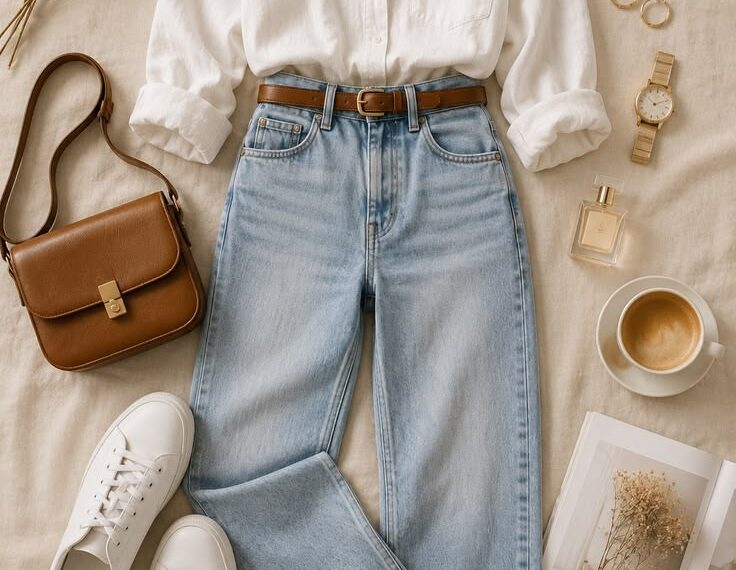
1. The perfect white shirt
Not a stiff office shirt and not a see-through fashion piece — a well-cut white button-down or relaxed blouse in a fabric that survives real life. It works tucked into jeans, layered under a blazer, knotted at the waist over a dress, and open as a light jacket. Buy the best quality you can afford here; this is the hardest-working piece you will own.
2. Dark straight-leg jeans
Dark wash, no distressing, a rise that sits comfortably at your waist. Dark jeans dress up with a blazer and heels and dress down with sneakers without ever looking sloppy. They are the single most versatile bottom in a capsule, and the one worth trying on in person until the fit is right.
3. A tailored blazer
One blazer in a neutral — black, navy, or charcoal — instantly upgrades jeans, dresses, and trousers alike. Look for a shape that skims rather than squeezes, with shoulders that sit exactly on your own. A blazer is the difference between “nice outfit” and “she looks polished,” and it earns its place in every season except high summer.
4. A little black dress
Not necessarily short and not necessarily fancy. Your little black dress is the one dress you can wear to dinner, a funeral, a work event, and a wedding guest slot just by changing shoes and accessories. A simple knee-length cut in a quality crepe or jersey is nearly indestructible and never dates.
5. A quality white T-shirt
The difference between a $10 tee and a $40 tee is usually the fabric weight and the cut — and it shows in every photo. A good white tee should be opaque, hold its shape after washing, and sit neatly at your waistband. Own two if you wear them weekly; they are the base layer of half your outfits.
6. A midi skirt
A midi skirt in a neutral or subtle print gives you a third option beyond pants and dresses. A-line cuts flatter almost everyone, and a midi length works with flats, boots, and heels across three seasons. It is also the easiest piece to dress up or down with a simple shoe swap.
7. Comfortable leather shoes
One pair of leather shoes you can walk in all day — loafers, ballet flats, or clean white leather sneakers, depending on your life. Shoes are where cheap shows fastest, so this is the second place to spend more. Well-made leather shoes can be resoled and worn for a decade; fast-fashion shoes rarely survive a season.
8. A classic trench or wool coat
Your outerwear is the first thing people see for half the year, so it deserves capsule status. A trench coat covers spring and fall; a wool coat covers winter. Either way, choose a classic cut in a neutral color and you will reach for it for ten years or more.
9. A cashmere or merino sweater
One great sweater beats five mediocre ones. Merino wool regulates temperature, resists odor, and layers beautifully under blazers and coats. Choose a crew or V-neck in your core neutral and it will quietly anchor dozens of outfits.
10. Well-fitting trousers
A pair of trousers that fit you perfectly — not almost, perfectly — in black or navy. These are your “I mean business” pants for work, interviews, and any day you want to feel sharp. Tailoring a $60 pair of trousers for $20 often beats buying a $150 pair off the rack.
11. A versatile tote bag
A structured tote that holds a laptop, a book, and your daily essentials without looking like luggage. Leather or heavy canvas, minimal hardware, neutral color. Your bag is in every outfit photo you take, so make it count.
12. One signature accessory
A silk scarf, a bold necklace, a great belt, a watch you love — one piece that is unmistakably yours. Accessories are how a capsule wardrobe avoids monotony: the same twelve essentials look completely different with a scarf knotted at the neck versus a statement necklace versus nothing at all.
The 5-Step System to Build Your Capsule
Step 1: Audit what you already own
Pull everything out — yes, everything — and sort it into three piles: love and wear, maybe, and no. Be honest about the “maybe” pile: if you have not worn it in a year and it does not fit your life now, it goes. Most people discover they already own six to eight of the twelve essentials. Our step-by-step companion guide on how to build a capsule wardrobe walks through this audit with a room-by-room checklist.
Step 2: Define your color palette
Pick two neutrals (for example black and cream, or navy and gray) and one or two accent colors you love and already wear often. Every new purchase must match your palette. This single rule is responsible for most of the magic: when everything matches, everything multiplies.
Step 3: Fill the gaps, not the closet
Make a list of the essentials you are missing — usually three to five items — and buy only those, in the best quality your budget allows. A short, specific shopping list is the antidote to impulse buying. If you want the full printable version, our capsule wardrobe checklist covers every category, season by season.
Step 4: Plan outfits, not just pieces
Before the season starts, spend thirty minutes creating ten to fifteen outfits from your capsule — on paper, in a notes app, or by photographing combinations. This is the step most people skip, and it is the step that makes mornings effortless. When you already know the outfits work, you stop standing in front of the closet guessing.
Step 5: Do a seasonal review
At the end of each season, spend twenty minutes reviewing: what did you wear constantly, what did you never reach for, what wore out? Remove the unworn, repair the damaged, and note the one or two gaps to fill next season. A capsule wardrobe is a living system, not a one-time project.
Seasonal Planning at a Glance
A capsule wardrobe changes with the weather, but the system stays the same. Use this rhythm to plan each season without starting over:
| Season | Keep from last season | Swap in | Store away |
|---|---|---|---|
| Spring | Jeans, tees, blazer, loafers | Trench coat, midi skirt, light sweater | Heavy wool coat, thick knits |
| Summer | Jeans, tees, white shirt, sandals | Linen pieces, one summer dress, sunglasses | Coats, heavy sweaters, boots |
| Fall | Jeans, blazer, ankle boots, sweater | Trench or wool coat, scarf, darker palette | Linen, summer dresses, sandals |
| Winter | Sweater, trousers, coat, boots | Thermal layers, wool accessories, one evening piece | Light jackets, open shoes, linen |
The rule is simple: at each changeover, only the outer layers and fabrics change. Your core — the jeans, the tees, the blazer, the shoes that fit your life — stays put. That is why a capsule wardrobe gets easier every season: the foundation is already built, and each refresh is a small edit rather than a rebuild.
Capsule Wardrobe vs. Fast-Fashion Closet: The Honest Comparison
| Factor | Capsule wardrobe | Fast-fashion closet |
|---|---|---|
| Pieces per season | 30–40 | 100+ |
| Average cost per wear | Low (pieces worn 30+ times) | High (pieces worn under 10 times) |
| Morning decision time | Under 10 minutes | 20+ minutes |
| Closet clutter | Minimal | Overflowing |
| Environmental impact | Much lower | Much higher |
| Style consistency | Strong personal signature | Trend-chasing, inconsistent |
| Upfront effort | One focused weekend | None — but daily friction forever |
The fast-fashion closet feels easier because the effort is spread out — a little frustration every morning, a little guilt every cleanup. The capsule asks for effort once, up front, and then pays you back daily. That trade is worth making.
5 Costly Mistakes That Wreck a Capsule Wardrobe
Mistake 1: Copying someone else’s list exactly
A capsule list from a stranger on the internet was built for her life, her climate, and her body. If you work from home in Arizona, you do not need the same pieces as a commuter in Chicago. Use the twelve essentials as a framework, then adapt ruthlessly to your actual life. A capsule that does not fit your real days will be abandoned within a month.
Mistake 2: Buying everything at once
The fastest way to waste money on a capsule is to buy all thirty pieces in one shopping spree. You will guess wrong on at least a third of them. Build slowly: start with what you own, fill two or three gaps, live with the capsule for a month, then adjust. The best capsules are edited over seasons, not purchased in a weekend.
Mistake 3: Choosing style over fit
A beautiful piece that does not fit you will sit unworn, and in a small wardrobe, every unworn piece hurts twice as much. Fit beats brand, trend, and even fabric. If it pulls, gaps, or needs constant adjusting, it does not belong — no matter how good it looked on the hanger.
Mistake 4: Forgetting your real life
Your capsule must cover your actual calendar: work, school runs, gym, date nights, family events. Count how you really spend your days before you choose pieces. A wardrobe full of office blazers is useless if you spend 80 percent of your time in casual settings, and vice versa. Build for the life you have, not the life you imagine.
Mistake 5: Treating it as a rulebook instead of a system
The “33 pieces” or “37 pieces” numbers you see online are guidelines, not laws. If your capsule works better at 45 pieces, it works. If you need a second pair of work shoes, get them. The point is intentionality, not a number. People who quit capsules usually quit because they turned a helpful system into a punishing set of rules.
Pro Tips From a Decade of Capsule Dressing
- Photograph your favorite outfits. Keep an album on your phone. On a rushed morning, scroll and copy — no thinking required.
- Use the hanger trick. Turn all hangers backward at the start of a season. After you wear something, turn its hanger forward. At season’s end, the backward hangers tell you exactly what to let go.
- Invest where it shows. Spend more on shoes, coats, and bags — the pieces people actually notice and that wear hardest. Save on tees and basics where quality differences are smaller.
- Keep a running “buy list.” When you notice a gap mid-season, write it down instead of impulse-buying. Review the list before the next season starts and buy deliberately.
- Shop secondhand first. Before buying a gap piece new, check resale and thrift options — and check brand sustainability ratings on Good On You so the pieces you do buy new come from brands that treat people and the planet decently.
- Learn basic repairs. A missing button or a loose hem should not retire a good piece. Ten minutes with a needle and thread saves a $60 replacement.
- Choose fabrics that forgive. Cotton blends, merino, and quality denim hold up to repeated wear. Delicate fabrics that demand dry cleaning after every wear do not belong in a hard-working capsule.
- Shop your own closet first. Before buying anything new, check whether a piece you already own — restyled, tailored, or simply paired differently — fills the gap.
Mini Case Study: How Sarah Cut Her Closet in Half and Got Dressed Faster
Sarah, a 34-year-old marketing manager in Austin, owned roughly 120 pieces and still said she had “nothing to wear” most mornings. She spent an average of 25 minutes getting dressed and bought something new almost every weekend to fill a gap that never actually closed.
Over one weekend, she audited her closet down to 38 pieces for the season, defined a palette of black, white, and olive with a rust accent, and planned twelve outfits in advance. The first month felt strange — she kept reaching for pieces that were gone. By the second month, her mornings took nine minutes. By the end of the season, she had spent $210 total on clothing, down from her usual $600-plus, and she could name every piece she owned and why it was there.
Her one regret? Buying three new pieces in the first week instead of living with the audit first. “Two of them I never wore,” she says. “The capsule taught me that waiting a month before buying is the whole secret.”
Frequently Asked Questions
How many pieces should a capsule wardrobe have?
Most capsule wardrobes run 30 to 40 pieces per season, including shoes but excluding underwear, sleepwear, and workout clothes. The exact number matters less than the principle: every piece should match several others and earn its place by being worn regularly.
How much does it cost to start a capsule wardrobe?
If you audit first, most people already own more than half the essentials. Filling three to five gaps with quality pieces typically costs $200 to $400. That sounds like a lot until you compare it with a year of impulse buys — and the pieces last far longer.
Can a capsule wardrobe work for plus sizes?
Absolutely — and the fit-first rule matters even more here. The system is about structure, not size: a tight palette, versatile pieces, and honest auditing work at every size. Our guide on capsule wardrobe for women covers fit, proportions, and brands by body type in detail.
Do I have to get rid of everything I own?
No. A capsule wardrobe is about what you keep in active rotation, not what you are allowed to own. Sentimental pieces, occasion wear, and off-season clothes can live in storage. The capsule is the working set you reach for daily.
How do I handle different seasons?
Keep a core of year-round pieces — jeans, tees, blazers — and rotate seasonal layers around them. Store off-season items out of sight so your closet only shows what is relevant now. A seasonal review at each changeover keeps the system fresh without a rebuild.
Is a capsule wardrobe only for minimalists?
No. Minimalism is an aesthetic; a capsule wardrobe is a system. Your capsule can be colorful, bold, and full of personality — it just has to be intentional. Plenty of maximalist dressers use capsule structure to make their bold pieces work harder.
What if I get bored wearing the same clothes?
Boredom usually comes from wearing the same combinations, not the same pieces. Thirty pieces can create hundreds of outfits when you vary layers, accessories, and shoes. The outfit-planning step in this guide exists precisely to break the “same outfit” rut.
How often should I replace capsule pieces?
Quality basics last years, not months. Replace a piece when it is worn out, damaged beyond repair, or no longer fits your life — not when a new trend appears. Most capsule dressers replace only three to five pieces per season.
Conclusion
A capsule wardrobe is not about having less for the sake of less. It is about ending the daily friction of a closet that does not work, stopping the slow leak of money into clothes you never wear, and finally knowing — every single morning — that everything you own looks good together and feels like you.
Start this weekend, not next season. Audit your closet, find your palette, fill two or three gaps, and plan ten outfits. That is the whole system, and it is enough. The twelve essentials in this guide are your foundation; the mistakes above are your warning signs; and the seasonal review is what keeps it working year after year.
Your closet should make your life easier, not harder. Build the capsule, and let it.
Your Next Step: The Companion Guides
When you are ready to go deeper, explore our companion guides: how to build a capsule wardrobe for the full step-by-step build system, capsule wardrobe checklist for the printable season-by-season checklist, and capsule wardrobe for women for fit, proportions, and styling by body type. Your future self — dressed in nine minutes flat — is already grateful.
About the Author
Laibii Publisher is the founder and editor of FreshMags, where she covers fashion, finance, education, and health with practical guides that save readers time and money. Her capsule wardrobe series helps women build smaller, smarter closets without giving up personal style.


 By